Tuesday, June 28, 2011

RePost: Communism and our Facist-capitalism, er ..."Democracy"

I read Animal Farm by George Orwell for the first time recently thanks to the exhortations to do so from my good friends Isaiah and Caleb, and boy, o, boy was I well rewarded with that time spent it.  I loved it, loved it!  Orwell really is amazing.  There were numerous passages I wanted to put on the blog but the one below made the cut.  First, though, a word of explanation.
For those who haven't read Animal Farm it concerns a farm (suprise, surprise) where the animals are convinced by an old boar before he dies that the humans must be expelled from the farm by revolution.  If they are able to do that, they are told, an utopia will then naturally follow and be put in place.  The revolt soon happens and the human owners are driven out.  A communistic government is established where one pig, Napolean, places himself in charge.  His police are the dogs and his administration is stocked with all the other pigs.  "Squealor" is Napolean's spokesperson.
         
Now, with that background read the passage below -- written in 1946 -- and see how eerie the animals "communist" government that Orwell describes sounds an awful lot like what we like to call our "capitalist democracy".  Hold tight and enjoy the great Orwell.
   
                    -------------------------------------------------------------------------------
"Somehow it seemed as though the farm had grown richer without making the animals themselves any richer -- except, or course, for the pigs and the dogs.  Perhaps this was partly because there were so many pigs and so many dogs.  It was not that these creatures did not work, after their fashion.  There was, as Squealor was never tired of explaining, endless work in the supervision and organization of the farm.  Much of this work was of the kind that the other animals were too ignorant to understand.  For example, Squealor told them that the pigs had to expend enormous labors every day upon mysterious things called "files", "reports",  "minutes", and "memoranda".  These were large sheets of paper which had to be closely covered with writing, and soon as they were so covered, they were burnt in the furnace.  This was of the highest importance for the welfare of the farm, Squealor said.  But still, neither pigs nor dogs produced any food by their own labor; and there were very many of them and their appetites were always good."


(Repost from June 28, 2011) 

Saturday, June 25, 2011

Full-orbed, up, down, left to right, inside, outside, no compartmentalization, discipleship of Christ's covenant children

"What is education for? And more specifically, what is at stake in a distinctive Christian education? What does the qualifier Christian mean when appended to education? It is usually understood that education is about ideas and information (though it is also too often routinely reduced to credentialing for a career and viewed as a ticket to a job). And so distinctively Christian education is understood to be about Christian ideas—which usually requires a defense of the importance of “the life of the mind.” On this account, the goal of a Christian education is the development of a Christian perspective, or more commonly now, a Christian worldview, which is taken to be a system of Christian beliefs, ideas, and doctrines. But what if this line of thinking gets off on the wrong foot? What if education, including higher education, is not primarily about the absorption of ideas and information, but about the formation of hearts and desires? What if we began by appreciating how education not only gets into our head but also (and more fundamentally) grabs us by the gut—what the New Testament refers to as kardia, “the heart”? What if education was primarily concerned with shaping our hopes and passions—our visions of “the good life”—and not merely about the dissemination of data and information as inputs to our thinking? What if the primary work of education was the transforming of our imagination rather than the saturation of our intellect? And what if this had as much to do with our bodies and with our minds? What if education wasn’t first and foremost about what we know, but about what we love?"

- Excerpt from Desiring the Kingdom: Worship, Worldview and Cultural Formation by James K. A. Smith (my thanks to Laurence Windham for passing this along)

Tuesday, June 21, 2011

A Litmus Test: Spanking

When we initially meet a brother or sister in Christ we often desire to get a firm grasp as to what that fellow Christian believes concerning the Scriptures and it's authority.
     One quick, simple way to do so is to endeavor to draw them out by asking them what their opinion is concerning the discipline of children by spanking (though, you may not need to ask if you've been exposed to their children for a period of say, five minutes). You will find that this one seemingly inane question will reveal with sublime accuracy not only their view of the Word, but too, their understanding of God.


(I've decided that from time to time I will "reprint" some of my favorite blog entries from months past and set them before some fresh, visiting eyes.  I've noticed quite a number of new readers to the blog as of late, and heard from some of you, and so I thought I'd set this one out on the table again for everyone to look at before it fades into the archives.  Plus, I found an excellent picture to go with it.  Enjoy.) 

Sunday, June 19, 2011

Clive Staples Lewis' Most Influencial Books

I discovered this list below in a book I was recently thumbing through and thought I'd pass it on. 

In 1962, the magazine Christian Century asked Lewis what were the top 10 books, other than the Bible, that had most influenced his life and thought.  These weren't  necessarily his favorite or what he'd claim to be the most important, but ones he believed had been most instrumental in molding him.  Kinda cool to see what books the Spirit used to shape his life.  Anyway, here they are.


- Phantastes by George MacDonald (fantasy fiction)
- The Everlasting Man by G.K. Chesterton (theology)
- The Aeneid by Virgil (narrative poetry)
- The Temple by George Herbert (poetry)
- The Prelude by William Wordsworth (narrative poetry)
- The Idea of the Holy by Rudolf Otto (philosophical theology)
- The Consolation of Philosophy by Boethius
- Life of Sameul Johnson by James Boswell (biography)
- Descent into Hell by Charles Williams (fantasy fiction)
- Theism and Humanism by Arthur Balfour (philosophical theology)

Friday, June 17, 2011

God and Government

If you don't have this book God and Government: A Biblical, Historical and Constitutional Perspective by Gary DeMar (or books, it originally came out in three volumes) you really should get it.  It is firmly grounded in Scripture and provides an excellent,  comprehensive  view of  how the civil government is to minister to the people of the Kingdom of Christ -- that is, the whole Earth, not just the Church -- according to the Word of God.  Check it out here: American Vision

Tuesday, June 14, 2011

The Spurge on Repentence

"A man may hate sin just as a murderer hates the gallows, but this does not prove repentance. If I hate sin because of the punishment, I have not repented of sin. I merely regret that God is just. But if I can see sin as an offense against Jesus Christ, and loathe myself because I have wounded Him, then I have a true brokenness of heart."

        - Charles Spurgen

Saturday, June 11, 2011

Open up that Bible and...listen?

       Quite a number of years ago while reading through the Scriptures, I began to notice that God – through His representatives/leaders – constantly called His People to “listen” or “hear” His Words (Nehemiah 8.2; Deuteronomy 31.9-13; 2 Chronicles 15.2; John 10.27; Acts 13.44; Hebrews 3.7) and it was rare to find an exhortation to read the Word.  Now, of course, we live in a privileged age where Christ has poured out His grace in a waterfall by giving us His Word printed out to read in wide abundance and accessibility, especially in the West. This fact is a beautiful one, and one in which we’ve been given much more than previous generations and thus will no doubt be held to a higher standard of accountability before Him. A daunting reality, but glorious nonetheless. 
        So, when it comes to understanding the “hearing” passages of Scripture we are in a slightly different situation than ancient Israel was because unlike a Hebrew in ancient Israel, I can’t swing a cat by its tail and not have it hit...

Wednesday, June 8, 2011

Some worthy pro-life organizantions


Here's a few pro-life organizations that I recommend
 that are performing radical, bold discipleship for Christ,
and against the waning powers of the Devil.


And Lifeline Pregnency Center in Nampa, Idaho.  Wonderful work is being done there.  Godly, dedicated followers of Jesus run the center and babies are being saved on a routine basis. 
Support them if you can in prayer and $$$.

Sunday, June 5, 2011

Strategic Points in Sanctification

"Good and evil both increase at compound interest.  That is why the little decisions you and I make every day are of such infinite importance. The smallest good act today is the capture of a strategic point from which, a few months later, you may be able
to go on to victories you never dreamed of."
  
C.S. Lewis, from his book Mere Christianity

Thursday, June 2, 2011

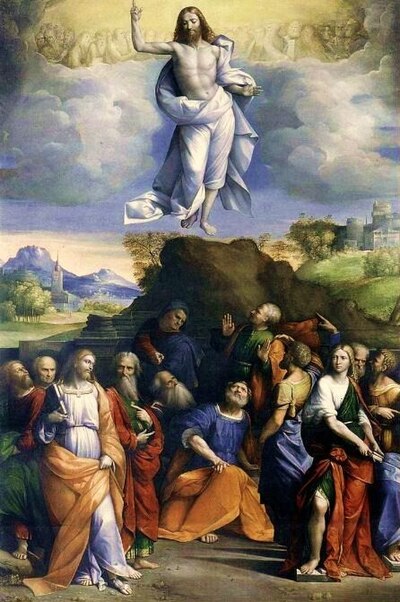
Ascension Day: Seeing it like Abraham and not like Thomas

Today is Ascension Day, and has traditionally been observed on the 40th day from Resurrection Day (i.e. "Easter") following the chronology in the Book of Acts 1:3 that states Jesus appeared to His disciples for 40 days after His resurrection. 
       This is the day that Jesus -- during His trial with the high-priest and elders right before His crucifixion -- was referring to when He declared that they would see Him the "Son of Man seated at the right hand of Power and coming on the clouds of Heaven." (Matthew 26:64-65; Luke 22:69).  This "coming on the clouds" talk wasn't concerning some distant, apocalyptic time in the future; No, this is Jesus declaring that He is the Son of Man spoken of by Daniel in chapter 7:13-14.  Jesus was declaring to be the person who will come on the clouds to the Ancient of Days and be "given dominion and glory and a kingdom, that all peoples, nations, and languages should serve Him; His dominion is an everlasting dominion, which shall not pass away, and His kingdom one that shall not be destroyed." And in both Matthew and Luke Jesus declares to the elders and high-priest that "from now on..." they will see Him as the triumphant, ruling Son of Man, and not future "somebodies" "someday" in the by-and-by.
     So, we see Jesus was given the Earth 2000 years ago as His Kingdom, and beware, it wasn't just a "heart" or "spiritual" kingdom either.  And why it cannot be an ethereal kingdom is due to what Daniel says this Son of Man will be given by God.  The Son of Man (Jesus) is said to be given people, nations, and languages; and that entails living bodies, corrupt governments, tornados, sloshing oceans, and oh, I don't know...   ponies and aardvarks.  You get the drift.
     This is extremely difficult for us to see...